Tuesday, December 14, 2010

Vidarbha farmers urged PM to sack union minister Vilasrao Deshmukh after Supreme Court slams for protecting the moneylenders

Vidarbha farmers urged PM to sack union minister Vilasrao Deshmukh after Supreme Court slams for protecting the moneylenders

Nagpur, Dec 14

The Supreme Court today snubbed Heavy Industries Minister Vilasrao Deshmukh and told him to stay away from interfering with the functioning of authorities under the money lending act.

The apex court told the Union Minister, who was also a former Chief Minister of Maharashtra, that he had no business to interfere with the authorities in directing a superintendent of police not to register an FIR on complaints made by the farmers alleging money lending by MLA Dilipkumar Sananda and his family in 2006.

The judgment came in a petition filed by Sarnagdharsingh Chavan representing the Vidarbha farmers, who had sought quashing of Deshmukh's directions to stall investigations against Sananda. "Chief Minister had no business to interfere with the functioning of authorities under the money lending Act," the court said.

This was challenged by the Maharashtra government in SC and a notice was issued to Deshmukh. It also slapped a fine of Rs. 10 lakh to be paid by the state government to state legal authorities within six weeks.

‘This is historic decision and duly endorsed our stand the local MLAs are getting political protection with top leaders and are exploiting the debt trapped farmers who are committing suicides hence we have urged Indian prime minister to sack Heavy Industries Minister Vilasrao Deshmukh and take legal action against him and local MLA Dilipkumar Sananda who is running parallel Govt. in vidarbha” Kishor Tiwari of Vidarbha Jananaolan Samiti (VJAS ) informed in press release today.

‘One should know that petitioner in this case by Sarnagdharsingh Chavan is close relative Indian Prez.Pratibhatai Patil but even after High Court Mumbai intervention ,Maharashtra failed to take the action moved in the supreme court that’s much more shocking and this is not single case in isolation most of political leaders and MLA and M.P. VJAS has brought another shocking fact before the Prime Minister that more than 70% finance for cotton crop cultivation is given by private micro finance institutes MFI as against Rs.9600 crore total cost of cultivation ,state owned banks have given only Rs.1460 crore which has been most disturbing facts that is adding fuel in the despair of farmers as MFI style of finance and recoveries are through local self help group(SHG) which are now acting as shelf recovery group(SRG) which needs to be banned immediately to stop innocent victimization debt trapped cotton farmers.

‘The cotton crop failure in Maharashtra is very serious issue but in the recent announcement the on Maharashtra agrarian crisis and Rs.1000 crore bail out package have not covered hence we have approached chief minister who is keen to bring Maharashtra agrarian economy on track and wants to stop on going cotton farmers suicides. VJAS has promised all constructive help to the Maharashtra chief minister if he is really serious to address the mass genocide of farming community as cotton farmers economic crisis is policy driven not the nature driven ’Tiwari assured .


Monday, December 13, 2010

शेतकऱ्यांच्या आत्महत्या-विधानसभेत मंत्र्यांनी दिली चुकीची आकडेवारी-विदर्भ जनआंदोलन समिती =लोकसत्ता

शेतकऱ्यांच्या आत्महत्या-विधानसभेत मंत्र्यांनी दिली चुकीची आकडेवारी
विदर्भ जनआंदोलन समिती..... लोकसत्ता

नागपूर, १२ डिसेंबर/प्रतिनिधी
राज्याचे पुनर्वसन मंत्री पतंगराव कदम यांनी विधानसभेत विदर्भाच्या शेतक ऱ्यांच्या आत्महत्येची गेल्या दहा वर्षांतील आकडेवारी सादर करताना सभागृहाची दिशाभूल केली असल्याचा आरोप विदर्भ जनआंदोलन समितीने केला आहे. कदम यांनी सरकारच्या आकडेवारीनुसार विदर्भातील आत्महत्याग्रस्त शेतक ऱ्यांची आकडेवारी ८ हजारांवर असताना, त्यांनी फक्त ४ हजार ४०० आत्महत्या झाल्याची चुकीची माहिती दिली असल्याचा दावा समितीने केला आहे.
विदर्भ जनआंदोलन समिती गेल्या दहा वर्षांपासून आत्महत्या करणाऱ्या प्रत्येक शेतक ऱ्याची नोंद करीत आहे. कदम यांनी सादर केलेली आकडेवारी पश्चिम विदर्भातील कापूस उत्पादक क्षेत्रात झालेल्या आत्महत्यांपेक्षाही निम्मे आहे. विशेष म्हणजे राज्य आणि केंद्र सरकारच्या गृहखात्याने संकेतस्थळावर याबाबत सादर केलेल्या अधिकृत माहितीत व केंद्रीय कृषी मंत्री शरद पवार यांनी संसदेत सादर केलेल्या आत्महत्याग्रस्त शेतकऱ्यांच्या माहितीत समितीच्या यादीची पुष्टी केली असल्याचा दावा केला आहे. समितीने २००१ ते २०१० या दहा वर्षांच्या काळात ८ हजार ७०२ आत्महत्या झाल्या आहेत. विशेष म्हणजे केंद्राच्या संकेतस्थळावर विदर्भातील आत्महत्याग्रस्त शेतक ऱ्यांची हीच आकडेवारी आहे. तर राज्य सरकारच्या संकेतस्थळावर पश्चिम विदर्भातील आत्महत्याग्रस्त शेतक ऱ्यांची अधिकृत आकडेवारी ६ हजार ३३१ देण्यात आली आहे.
कदम यांनी दिलेली आकडेवारी दिशाभूल करणारी असून विदर्भात जून २००५ पासून प्रत्येक ८ तासाला एक शेतकरी आत्महत्या करीत आहे. आत्महत्याग्रस्त शेतक ऱ्यांच्या कुटुंबियांना मदत देण्याचे सोडून शेतकरी आत्महत्यांचा कमी आकडा दाखवण्यातच सरकार धन्यता मानत आहे. शेतकरी आत्महत्यांची कमी आकडेवारी सादर करून या गंभीर प्रश्नावर सरकारने पांघरून घालण्याचा प्रयत्न केला आहे.
विदर्भ जनआंदोलन समितीने या प्रकाराची गंभीर दखल घेतली असून आतापर्यंत आत्महत्या केलेल्या शेतक ऱ्यांची यादी सादर करण्याची तयारी दर्शवली असल्याचे समितीचे किशोर तिवारी यांनी पत्रकाद्वारे कळवले आहे.

Thursday, December 2, 2010

Church supports vidarbha farmers’ protest

Church supports farmers’ protest

Church supports farmers’ protest thumbnail
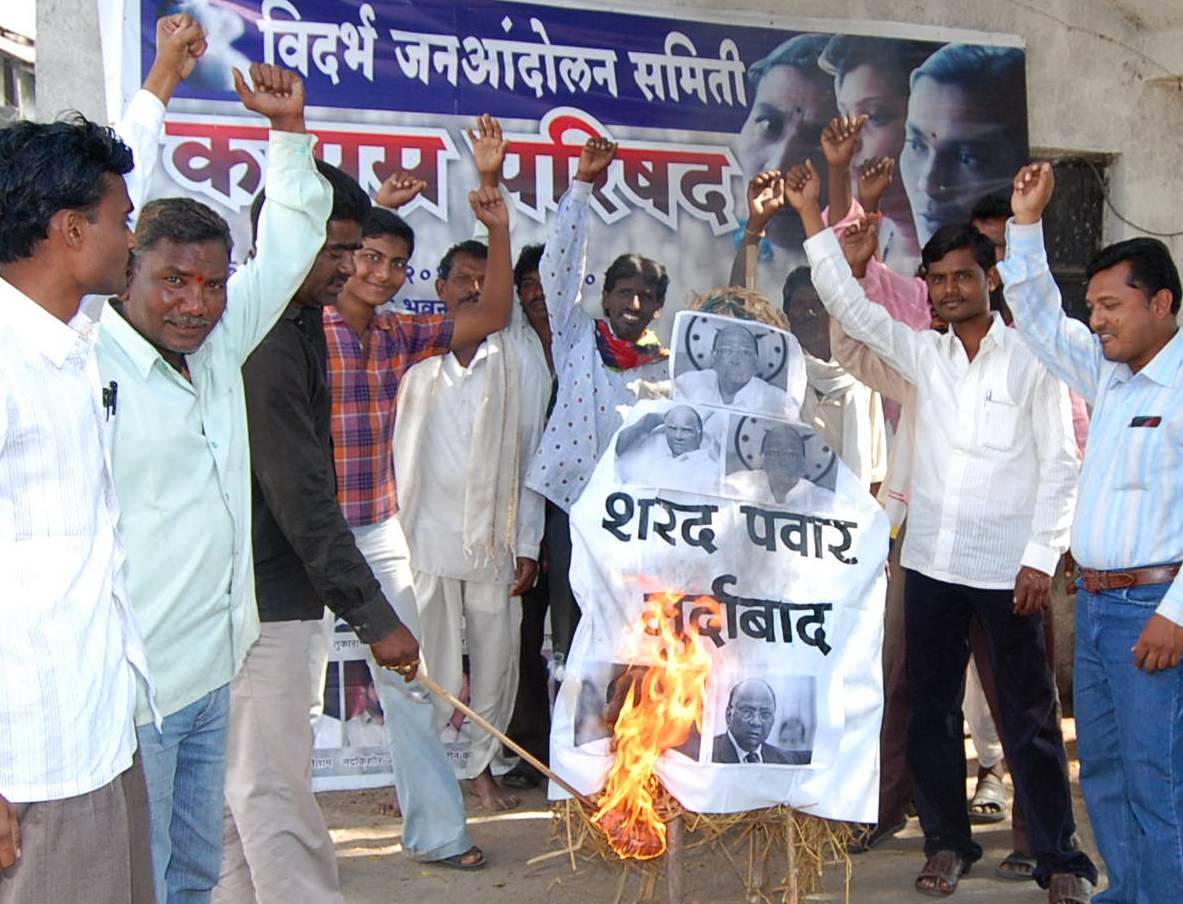
Agitating farmers in Vidarbha region burning an effigy of Union agriculture minister Sharad Pawar

The Church in Maharashtra has extended its support to the debt-ridden farmers protesting against the government’s refusal to increase the minimum price of cotton.

Some farmers of Vidharbha burnt effigies of federal Agriculture Minister Sharad Pawar and state Chief Minister Prithviraj Chauhan Nov. 29 and Dec. 1 at different places.

Pawar turned down their request to increase the support price of cotton from 3,000 rupees (US$67) to 4,200 rupees per quintal (100kg).

Farmers sought the minister’s intervention through their Maharashtra State Co-Operative Cotton Marketing Federation on Nov. 28. The support price is the minimum legal price a seller may charge.

“The farmers’ demand is just and the government should consider it,” said Father Jolly Puthenpura, who works among the debt-ridden farmers to rebuild their lives.

The priest told ucanews.com that an increase in the cost of production and loss of crops due to inclement weather has made it difficult for the farmers to repay their debts.

He went further than the farmer’s own co-op, saying that the support price of cotton should be “at least raised to 5,000 rupees,” the price at which certain private firms purchase it in the open market.

Kishor Tiwari, who is leading the protest, said the government’s refusal could cost some farmers their lives as they see no way out of debt other than suicide. At the very least it would hinder the process of rebuilding their lives.

Some 700 farmers have already committed suicide since January this year with 10 ending their lives this week alone, Tiwari said.

“Unless the governments come to the aid of cotton farmers by raising the support price, there will be more suicides, hunger death and withering of families,” Tiwari cautioned.

The Federation, in its finding, said more than 4.2 million hectares of cotton crops have been lost due to inclement weather in the region.

Wednesday, December 1, 2010

All roads lead to Nagpur for Gadkari son’s wedding-Indian Express

All roads lead to Nagpur for Gadkari son’s wedding

Vivek Deshpande
Posted: Dec 01, 2010 at 0339 hrs
http://www.expressindia.com/story_print.php?storyId=718366
1.“About 2.5 to 3 lakh people are expected to come on that day.
2.Nearly 20 chartered flights will land in Nagpur to bring in the guests. At least 18 VVIPs entitled to Z-category security are expected to attend the marriage reception.
3.top industrialists like Mukesh and Anil Ambani, Rahul Bajaj and Amitabh Bachchan. Many other industrialists and filmstars are coming
Nagpur On December 3, top BJP leaders will take a break from the Parliament logjam and head for Nagpur. So will senior NCP and Shiv Sena leaders, top industrialists, Sangh leaders, chief ministers of several states and other VVIPs. The occasion: not any mega political conclave but the wedding reception of BJP president Nitin Gadkari’s son Nikhil. Nikhil, who looks after Gadkari’s Purti Group of Companies, will marry Rutuja Pathak, a middle-class Nagpur girl, on December 2.

While the wedding will be a private affair with family members and a few other guests attending, VIPs and the political fraternity will be hosted at a reception the next day. The venue: the lawns of Vidarbha Cricket Association’s Jaamtha stadium, which recently hosted a India-New Zealand Test match.

Over 2,000 guests are expected to grace the occasion. “We have confirmation from top industrialists like Mukesh and Anil Ambani, Rahul Bajaj and Amitabh Bachchan. Many other industrialists and filmstars are coming,” sources at Gadkari’s residence said. Nearly 20 chartered flights will land in Nagpur to bring in the guests.

Among the big names are L K Advani, Sushma Swaraj, Shatrughan Sinha, Arun Jaitley, Venkaiah Naidu, Narendra Modi, B S Yeddyurappa, Shivraj Singh Chauhan and Murli Manohar Joshi.

NCP supremo Sharad Pawar, Shiv Sena leader Uddhav Thackeray, MNS leader Raj Thackeray, Union Aviation Minister Praful Patel and several senior Congress leaders are also expected to attend the reception. An invitation has also been sent to Congress president Sonia Gandhi, sources said.

Asked if top RSS functionaries will attend the function, sources said, “Yes, all are coming.”

On December 4, party workers and local office-bearers from across the country have been invited for dinner at the Reshimbag ground. “About 2.5 to 3 lakh people are expected to come on that day,” sources said.

Gadkari’s Purti Group of Companies, worth at least Rs 1,000 crore, controls sugar mills, power units, an ethanol plant, a solvent extraction plant and a supermarket chain.

The BJP chief calls his empire social entrepreneurship and claims his group has been running the businesses in loss to support Vidarbha farmers from whom he buys cane.

And while the mega-event goes on for three days, the Nagpur Police will have a difficult time organising security since it coincides with the winter session of the State Legislature beginning on December 1. A three-tier cordon comprising 9,000 policemen and over 1,200 officers has been deployed.

At least 18 VVIPs entitled to Z-category security are expected to attend the marriage reception.

Nagpur Commissioner of Police Ankush Dhanvijay had said at a recent press conference that there were inputs about a possible Naxal attack. “The DGP office in Mumbai has sent an input that a Naxal special action team might make pointed attacks. Naxals are, hitherto, not known to have done anything of this kind anywhere. Yet, we are not taking any chances,” a senior police officer said.

Monday, November 29, 2010

‘Vidarbha Farmers burnt effigy of Sharad Pawar’

Rejection of Cotton Price Rise Demand- ‘Vidarbha Farmers burnt effigy of Sharad Pawar’

Rejection of Cotton Price Rise Demand-

‘Vidarbha Farmers burnt effigy of Sharad Pawar’

kolzari-Yavatmal dated-29th November 2010

Sharad Pawar rejection of Maharashtra State Co-Operative Cotton Marketing Federation demand of raising cotton procurement price from Rs.3000 MSP to Rs.4200 per quintal has received very violent reaction mark by the protest all over vidarbha and VJAS activist has burnt the effigy of Union Agriculture Minister Sharad Pawar today protesting her announcement the demand of cotton price rise is baseless and central will not consider it.

Maharashtra State Co-Operative Cotton Marketing Federation silver jubilee function on November 28 in Mumbai amidst mounting losses and prospects of a lower cotton production of the produce this year in the state has left dying 3 million vidarbha cotton farmers most dejected when Union Agriculture Minister Sharad Pawar has rejected the demand made by Dr.N.P.Hirani chairman , Maharashtra State Co-Operative Cotton Marketing Federation that this year in Maharashtra record 42 lacs hector cotton has been lost due to wet drought and cotton cultivation cost has been double hence central Govt. to raise minimum support rice (MSP) to Rs.4,200 quintal from today’s Rs.3000/- per quintal which unchanged by CACP since 2007,Kishor Tiwari of Vidarbha Janndolan Samiti informed today .

“Sharad Pawar rejection to the chapter of demands of Maharashtra State Co-Operative Cotton Marketing Federation will certainly add fuel to farm suicide spiral which has claimec more than 8000 farmers since 2005 more over in last 48 hours seven more vidarbha farmers suicide have been reported and victims are identified as

1.Arun Mahurle of Chikhalgoan in Chandrapur

2.Hemant Padole of Of Borgoan inwardha

3.Yuvraj Pudakkare of Virali in Bhandara

4.Vijay Wankhede of Borgoan(Manju) in Akola

5.Sudhir Sable of Anakwadi in Amaravati

6.Zhaganlalan Rahgandale of Padulkoma iIn Gondia

7.Subhash Adhav of Uti in Yavatmal

Taking tally 688 in the year 2010 ,informed Kishor Tiwari of VJAS today

“Distressed and dying farmers needs food security ,health facility to critically ill members of distressed farming community and provision for direct financial assistance to daughter marriage along with free fodder and potable water but till date only promises are given ,not relief resulting these farmers suicides” alleged Kishore Tiwari of VJAS.

‘we are expecting central intervention to stop this mass genocide of innocent farmers who are victims of wrong policies promoted by state as in dry land area rain sensitive crop like Bt.cotton is being cultivated in more than 95% causing huge financial losses to the cotton farmers and water crisis in the area. We have demanding the ban on rain sensitive crop in this region and promotion of food crop in all rain fed area of vidarbha since 2004 but nobody is giving any attention to this serious demand resulting more and more farm suicides in the region’ Tiwari added,

"Only a price of 4,500 can help cotton growers tide over the difficult situation caused by excessive rains, we will ask all parties to help cotton growers of India,” VJAS stressed in press release today.

Pl arrange to publish this press note

KISHOR TIWARI

President

Vidarbha Jan Andolan Samiti

Saturday, November 27, 2010

पणन महासंघाचा रौप्य महोत्सव साजरा करणेम्हणजे शेतकऱ्यांच्या जखमेवर मीठ चोळणे विदर्भ जनआंदोलन समितीची टीका-लोकसत्ता

पणन महासंघाचा रौप्य महोत्सव साजरा करणेम्हणजे शेतकऱ्यांच्या जखमेवर मीठ चोळणे
विदर्भ जनआंदोलन समितीची टीका-लोकसत्ता


मुख्यमंत्री चव्हाण व कृषी मंत्री शरद पवार यांच्या उपस्थितीत आज मुंबईत रौप्य महोत्सव
http://loksatta.com/index.php?option=com_content&view=article&id=117817:2010-11-27-18-07-43&catid=45:2009-07-15-04-01-33&Itemid=56
नागपूर, २७ नोव्हेंबर/प्रतिनिधी
ज्या पणन महासंघाने भ्रष्टाचाराचा कळस गाठून महाराष्ट्र सरकारला ५ हजार कोटीचा चुना लावला व कापसाचा अग्रिम बोनस बंद करुन शेतकऱ्यांच्या आत्महत्येला वाट मोकळी केली, त्या पणन महासंघाने रौप्य महोत्सव साजरा करणे म्हणजे ३० लाख नैराश्यग्रस्त व कर्जबाजारी शेतकऱ्यांच्या जखमेवर मीठ चोळणे होय, अशी प्रतिक्रिया विदर्भ जनआंदोलन समितीचे नेते किशोर तिवारी यांनी व्यक्त केली आहे. शेतकऱ्यांना वाऱ्यावर सोडून या पणन महासंघाने यावर्षी एकही किलो कापूस घेतला नाही व त्या पणन महासंघाचा प्रशासकीय कारभार व इतर कामासाठी कोटय़वधीचा खर्च होत असताना जर पणन महासंघ कापूस उत्पादक शेतकऱ्यांना न्याय देत नसेल, तर या रौप्य महोत्सवी वर्षांतच या पणन महासंघाचे विसर्जन करावे, अशी मागणीही त्यांनी केली.
कापूस उत्पादक शेतकऱ्यांच्या प्रगतीसाठी व कापसाच्या बोंडापासून कापड तयार करण्याच्या प्रक्रियेपर्यंत शेतकऱ्यांच्या मालकीची संस्था तयार करण्याच्या उद्देशाने सरकारने कापूस एकाधिकार योजनेमध्ये निर्माण केलेल्या महाराष्ट्र राज्य कापूस उत्पादक पणन महासंघाच्या स्थापनेचा रौप्य महोत्सवी सोहोळा उद्या, २८ नोव्हेंबरला मुख्यमंत्री पृथ्वीराज चव्हाण व कृषीमंत्री शरद पवार यांच्या उपस्थितीत साजरा होत आहे, हे विशेष.
पणन महासंघाचा रौप्य महोत्सव साजरा करताना आघाडी सरकारने कापसाला ४ हजार ५०० रूपये प्रति क्विंटल भाव द्यावा, अशी मागणीही त्यांनी केली आहे. एकीकडे खासगी व्यापारी दररोज कापसाचे भाव पाडत आहेत आणि त्यावरही समाधान झाले नाही तर काटय़ामध्ये कमी वजन दाखवून खुलेआम शेतकऱ्यांची लूट करत आहेत. जगात कापसाला ५ हजार रुपये प्रति क्विंटल भाव असताना मुख्यमंत्री पृथ्वीराज चव्हाण व कृषीमंत्री शरद पवार याविषयी का बोलत नाहीत, असा सवालही समितीने केला आहे. ज्या पणन महासंघाने केंद्र सरकारला कापसाचा हमी भाव ४ हजार रूपये प्रति क्विंटल व्हावा, अशी मागणी केली आहे, त्या पणन महासंघाला विशेष निधी देऊन ४ हजार रूपये प्रति क्विंटल दराने कापसाच्या खरेदीची सुरुवात का केली जात नाही, असेही समितीने सरकारला विचारले आहे.
महाराष्ट्रात पणन महासंघाचा रौप्य महोत्सव समारंभ व १ डिसेंबरला नागपुरात सुरू होणारे अधिवेशन याचे निमित्त साधून महाराष्ट्र सरकारने ओल्या दुष्काळग्रस्त शेतकऱ्यांना प्रति एकरी १० हजार रूपये मदत व पणन महासंघाद्वारे कापसाची खरेदी किमान ४ हजार ५०० रूपये प्रति क्विंटल दराने करुन शेतकऱ्यांना दिलासा देण्याची मागणीही समितीने मुख्यमंत्री पृथ्वीराज चव्हाण यांना पाठवलेल्या पत्रात केली आहे.

Friday, November 26, 2010

Subhash Palekar and “Zero Budget Natural Farming” (ZBNF)


Subhash Palekar and

“Zero Budget Natural Farming” (ZBNF)

Subhash Palekar, popularly known as Krishi ka Rishi (the “sage of agriculture”), is a famous exponent of natural farming and a tireless promoter of the concept of “Zero Budget Natural Farming” (ZBNF). He hails from Amaravati (Maharashtra) but was born in the village of Belora, in the Vidarbha region of Maharashtra, which has been sadly notorious for its high percentage of farmer’s suicides these past two decades.

While his father was a traditional natural farmer, S. Palekar started practising chemical farming on their land, as he was taught in the college. Between 1972 and 1985 the production of his ‘modern’ farm increased regularly but, to his great surpise, it started declining from 1985. This unexpected result led him to thoroughly study the reasons of the decline in the yield and finally to develop the concept of natural farming.

From 1986 to 1988 he studied the ecosystem of the forests and the natural processes which enable the growth of so many fruits, plants and trees such as mango, ber, tamarind, jamulum, custard apple, neem, moha, without any intervention of human beings. As he himself explains « he found that there is a self developing, self nourishing and totally self reliant natural system in the forest, by which all the vegetation and ecosystem exist without any human existence ». Then, for six years (1989-1995), he verified these natural processes on his own farm through 154 research projects that led him to develop a method of natural farming which he called the “Zero Budget Natural Farming”.

Today, Subhash Palekar, who is still cultivating various crops on his 34 acre dry land property, dedicates himself to the propagation of his method all over India. He thus trains the farmers in this technique through camps, workshops, seminars, model farms settled throughout India, and publications in various Indian languages. About 30 lakh farmers have already successfully adopted natural farming over 10 millions of hectares.

The four principles of natural farming

Basically, natural farming aims at cultivating plants by promoting self-reliance of farmers while protecting the environment and stimulating harmony between humans, animals and plants for a sustainable development. The fundamental principle underlying natural farming is that every thing is connected to every thing else on earth as every function is served by many elements and every element has many functions. The relative placement of elements is thus an important key to the success of this method and requires a minutely detailed observation of nature in order to recreate in the fields the same kind of symbiosis, of interactivity between the plants.

farming is based on four principles:

1. Zero budget farming

The production cost for the farmer is zero as no input needs to be purchased. As 1.5 to 2.0 % of the nutrients are taken from the soil by the plant (the rest is taken from the air, water and solar energy), there is no need to add fertilizers. These nutrients provided by nature (as in the forest) are totally free of cost. The farmer uses its own seeds and protects the crop with natural products that he collects himself so that he does not have to buy either chemicals or seeds.

As a zero cost technique, natural farming is an appropriate answer to the current agriculture crisis and particularly to farmers’great indebtedness and dependence on money lenders, that increasingly leads too many of them to commit suicide.

2. Natural inputs

Natural farming does not require chemicals inputs or organic compost like vermiculture (S. Palekar considers these external inputs as as destructive as chemicals) but promotes a natural catalyst of biological activity in the soil and natural protection from diseases.

The nutrients (Nitrogen, Phosphate, Potash, Iron, Sulphur, Calcium) which are present in the soil are not in an available form for the plants. They first need to be transformed through the action of micro-organisms (bacteria, microbes and local earthworms) that are normally present in the soil as well. But the excessive use of chemicals have destroyed these micro-organisms. It is thus necessary to reintroduce them through natural methods like application of local cow dung which, according to S. Palekar, contains 3 to 5 millions of such beneficial microbes. His researches show that local cow dung (zebu) is the most effective compare to foreign cows (Jersey, Holstein). Only one cow is needed to cultivate 30 acres of lands (most Indian farmers own less than 1 acre) as one cow gives about 11 kilograms of dung per day and as only ten kilograms of local cow dung are required per month to cultivate one acre of land.

Observing nature, S.Palekar thus developed a natural “catalytic agent” known as Jivamrit to promote the formation of humus in the soil by encouraging the multiplication of micro-organisms that decompose the dried biomass of the soil and make it available as nutrients for the plants. The components of jivamrit are entirely natural: water, local cow dung, local cow urine, jaggery (sugarcane sugar), pulse’s floor and soil.

On the same pattern, he designed a seeds treatment formula to protect them from various diseases and insects, without using any pesticides: bijamrita is a natural mixture of water, local cow dung, local cow urine, soil and lime.

Other mixtures aimed at managing insects and pests (natural pesticides and fungicides) contain tobacco, green chili, garlic, neem, and various fruits such as custard apple, guava, lantena camella, papaya, white dhotara, pomegranate.

These natural catalysts, protections and treatments ensure the quality of the soil, the underground water and the crops. Preventing any deterioration or pollution of the environment and maintaining the productivity at a very good level on the long term, natural farming can thus be equated with sustainable agriculture.

3. Mulching

Mulching is also one of Zero Budget Natural Farming’s four wheels. It is necessary to create the micro-climate under which micro-organisms can best develop, that is 25 to 32 °C temperature, 65 to 72 % moisture and darkness and warmth in the soil. Mulching indeed conserves humidity of the soil (therefore diminishing the need for irrigation), cools it and protects its micro-organisms.

4. Multicropping

Intercropping, multicropping or mixed cropping, as opposed to mono-cropping which has been imposed by industrial and mechanised agriculture, is the cultivation of two or more crops in proximity in the same field, during a growing season, to promote interaction between them. It is based on the assertion that there is a complementarity between plants. Natural farming enhances the use of the soil and its nutrients through this complementarity between the crops.

For example, one could mix long life-span species (like chikoo, coconut, mango) with short life-span species (like various vegetables, leguminous, medicinal and aromatic plants) and medium life-span species (like banana, papaya, custard apple). The diversification of crops has to be decided according to the area and agro-climatic conditions.

Multicropping is a good way to minimize the risks for the farmer who is able to enjoy continuity of yield throughout the year. In case of a crop’s failure he can also rely on the other crops. Other advantages of intercropping include the limitation of outbreaks of crop pests (some plants act as natural pesticides against other crops’ pests) while rotation protects against endemic pests; the protection of biodiversity; a better and richer nutrition.

Who are the beneficiaries of natural farming ?

Natural farming focuses mainly on small communities and family settlements to whom it ensures livelihood and self-reliance. It prevents small farmers of being dependent on and exploited by firms and multi-national corporations that dominate the agricultural market of chemical inputs and seeds.

An assessment study with farmers from Karnataka who switched over natural farming after attending Subhash Palekar’s workshops shows that the model is effective and the benefits for the farmers are tremendous. As the author of the study states: “The system of zero budget natural farming is eminently suited to the farmers particularly small and marginal farmers because of its simplicity, adoptability and drastic cuts in cost of cultivation of crops. The appeal to the farming community lies in the fact that maintaining optimum levels of production and keeping the cost of cultivation to the bare minimum will substantially enlarge the profit margin.”

From an economic perspective, natural farming has proved more cost effective and input efficient than industrial farming as the farmers spend practically no money on inputs. For example, they would spend only Rs. 100-200 for one acre of paddy whereas they used to spend Rs. 3000 while practising chemical farming.

Natural farming is particularly suitable to small farmers who own only a few acres of land and do not have financial resources. Following the stagnation or even downfall in crops’ productivity in farms using modern technologies and tonnes of pesticides and fertilizers, natural farming proves to be more productive and this on a sustainable way. It actually ensures every farmer its livelihood. Whereas chemical farming turned to be a subsistance agriculture for small farmers, as the profits made from the sale of crops would not be sufficient to repay the loans raised to produce these crops, zero bubdget natural farming enables the famers to increase their returns. For instance the productivity of Basmati rice is about 24 quintals per acre through natural farming, against about 10 quintals in chemical farming.

Moreover, it requires only 10 per cent water and 10 per cent electricity than what is used under chemical and organic farming. Apart from being therefore less costly than modern farming, it is also adapted to the dryland areas that comprise 70% of the cultivable land in India and that have been completely neglected by the Green Revolution and the Government policies.

Natural farming also means diversification and increase of income sources by growing and selling different types of cereals, vegetables, legumes, fruits and even medicinal plants thanks to multicropping and low cost cultivation. For example, a farmer in Karnataka could ensure an additional income of 15,000 Rs. by cultivating ashwaganda, a medicinal plant, as intercrop with sugarcane.

Last but not least diversification of crops through natural farming provides nutritional balance and helps overcoming malnutrition which is rampant in Indian, especially in rural areas. Natural farming also free farmers, their family and neighbors from health hazards which were due to contamination by chemicals of the soil and groundwater.

In the last analysis, natural farming works as a rehabilitation for small scale farmers : it brings them back their dignity, pride, self-respect and self-confidence in their own knowledge and capabilities in making small scale agriculture a viable activity and way of life. Natural farmers emerge as the real experts in sustainable agriculture.